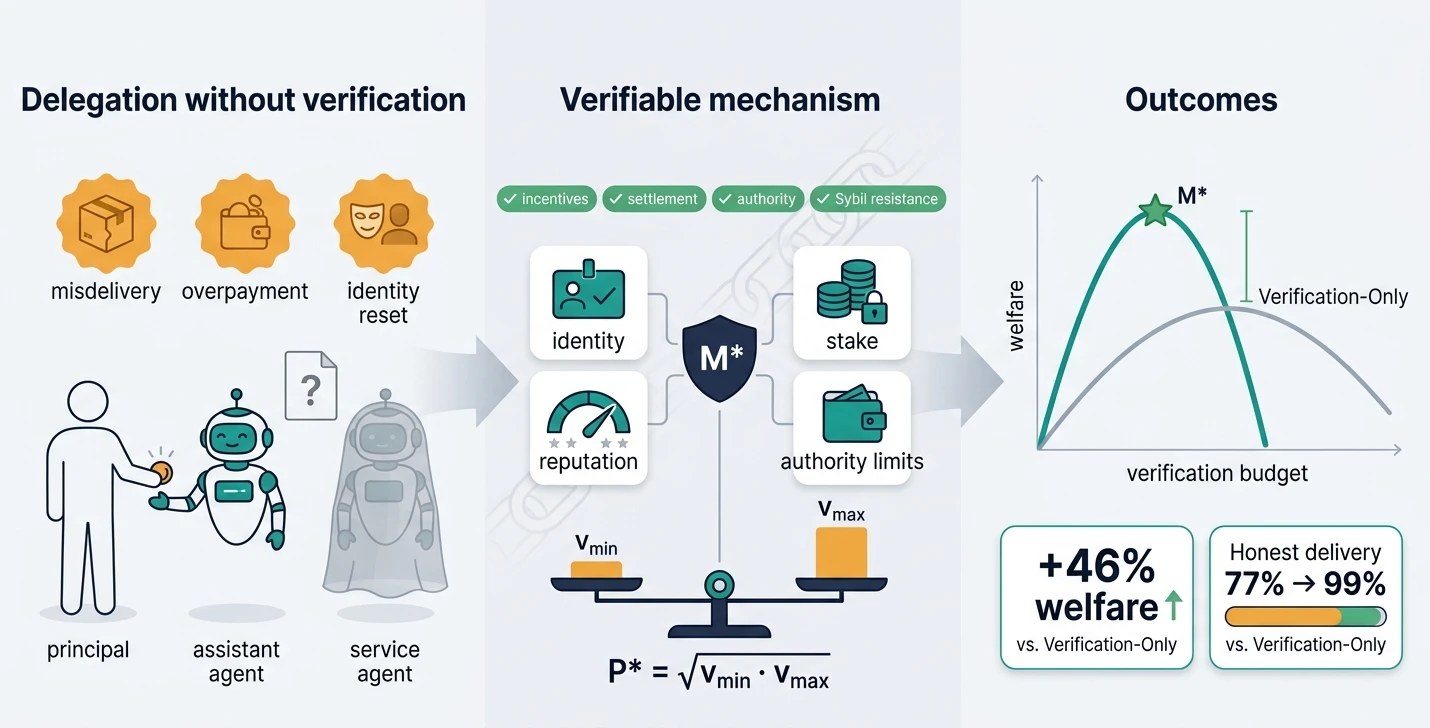
Delegation without verification leads to misdelivery, overpayment, and identity resets. The mechanism M* combines identity, stake, reputation, and authority limits with geometric-mean settlement.
Future Internet, 18(10), 532, 2026 · Special Issue Agentic Web: Collaborative AI Agents for Decentralized Economies and Autonomous Systems
Autonomous AI Agents · Verifiable Agent Economy · Autonomous Payments · Decentralized Identity
Autonomous AI agents discover services, negotiate, and settle payments. However, open agent markets lack reliable means to verify delivery, constrain delegated authority, and make identity renewal economically consequential. To address these failures, we formalize the verifiable agent economy, where evidence and programmable constraints govern identity, behavior, and payment. We introduce the agentic economy stack and formulate trust-asymmetric coordination through four requirements: delivery incentive compatibility, verifiable settlement, budget and authority safety, and Sybil resistance. To operationalize these requirements, we construct a blockchain-based mechanism combining verifiable credentials, stake, reputation, constrained wallets, and receipt-conditioned settlement. Within the class of receipt-conditioned payment rules, its geometric-mean payment rule minimizes worst-case multiplicative exposure to residual value uncertainty. The mechanism satisfies delivery incentive compatibility and Sybil resistance under explicit deterrence and identity-cost conditions, while its budget and authority guarantee is limited to actions routed through the enforcement path. Across five detection laws, numerical analysis identifies an interior verification-budget optimum. At their respective optima, our mechanism achieves 46% higher welfare than Verification-Only and raises honest delivery from 77% to 99%. A measured sampling-audit verifier shifts but preserves the optimum, while false positives and thin markets tighten participation and staking requirements.
In one sentence: Transactions between AI agents are hard to verify, and paying the geometric mean of the verified value range minimizes the worst-case loss for both buyer and seller.
AI agents are moving from doing work for people to spending money on their behalf: booking flights, negotiating services, and initiating payments. A principal who delegates such tasks struggles to confirm three things. Did the agent deliver at the agreed quality? Did it overpay? And what stops a penalized agent from adopting a new identity and starting over?
The paper illustrates the problem with a concrete case. A user asks a personal assistant agent to book a flight. The assistant selects a travel-service agent, negotiates a price, completes the payment, and the user receives a confirmation. The transaction looks successful, but the confirmation hides three possible failures:
None of these failures comes from weak agent reasoning. They arise because payment authority is handed over before identity, behavior, and delivery are reliably verifiable. The paper calls this class of problems trust-asymmetric coordination: the principal does not fully observe the agent's true capability, effort, or execution, so trust in the transaction is not something to assume.
The paper models the problem as a repeated Bayesian game and states four requirements that hold jointly:
The mechanism M* addresses the four requirements together. Credential-based admission binds identity, stake- and reputation-weighted matching selects service agents, constrained escrow controls the budget, and verification-conditioned settlement determines payment. The central element is the payment rule. When verification bounds the delivered value only to an interval [vmin, vmax], the mechanism pays the geometric mean:
P* = √(vmin · vmax)
After verification, the buyer knows only that the delivery is worth at least vmin and at most vmax. Paying vmin shortchanges the seller, paying vmax overcharges the buyer, and the arithmetic mean (vmin + vmax)/2 still leaves one side with a large worst-case deviation. The geometric mean equalizes the factor by which the buyer overpays and the factor by which the seller is underpaid, and this common factor is the smallest one any payment rule achieves.
The paper proves that, among all receipt-conditioned payment rules, geometric-mean pricing attains the minimal worst-case exposure bound √s, where s = vmax/vmin, and that this bound is tight. In the flight case, if verification only establishes that the ticket is worth between 100 and 400, the geometric-mean price is 200. The buyer overpays by at most a factor of 2 and the seller is underpaid by at most a factor of 2. Paying the arithmetic mean of 250 instead exposes the buyer to an overpayment of up to 2.5 times and the seller to an underpayment of up to 1.6 times, so the largest deviation grows.
The analysis also states when each guarantee holds. Honest delivery is sequentially optimal when detection probability, stake, and reputation continuation value satisfy an explicit inequality. Identity renewal is unprofitable when identity-creation cost and stake are high enough. Budget safety covers only actions routed through the constrained wallet and permission gates.
The numerical analysis finds an interior optimum for the verification budget. Too little verification leaves high residual risk, while too much lets verification cost consume welfare. Near the optimum, the mechanism achieves 46% higher welfare than Verification-Only and raises honest delivery from 77% to 99%. The interior optimum persists across five detection laws, a measured sampling-audit verifier, learning agents, and thin markets, although its location shifts with the verification technology.
The paper is explicit about what lies outside its guarantees: misrepresentation at the quoting stage, the assistant agent's own incentives, collusion among agents, and the physical evidence chain of embodied agents. For example, a misinterpreted instruction or a prompt-injection attack is enough to steer a faithful assistant toward the wrong transaction. Budget safety caps how much the assistant spends, but it does not guarantee that the spending matches the principal's intent.
M. M. Karim and Q. Qu, "Can We Trust Autonomous Agents? A Formal Framework for Verifiable Agent Economies," Future Internet, vol. 18, no. 10, p. 532, 2026. https://doi.org/10.3390/fi18100532
Karim, M. M., & Qu, Q. (2026). Can We Trust Autonomous Agents? A Formal Framework for Verifiable Agent Economies. Future Internet, 18(10), 532. https://doi.org/10.3390/fi18100532
@article{karim2026cantrust,
  title={Can We Trust Autonomous Agents? A Formal Framework for Verifiable Agent Economies},
  author={Karim, Md Monjurul and Qu, Qiang},
  journal={Future Internet},
  volume={18},
  number={10},
  pages={532},
  year={2026},
  doi={10.3390/fi18100532},
  publisher={MDPI}
}
DOI: 10.3390/fi18100532